
What an inspection actually is
A compliance inspection is conducted by an Industry Operations Investigator, an IOI, not a special agent. It is a regulatory inspection, not a criminal investigation, and the two are different things with different people.
In 2024, ATF conducted over 9,000 compliance inspections, which produced over 1,000 violation reports. Most licensees who are inspected are not found to be doing anything deliberate. They are found to have records that do not add up.
What the IOI looks at
- Your records. The A&D record and your Forms 4473, checked for completeness and accuracy.
- Your inventory against those records. This is the one that catches people: the book has to match the shelf, firearm by firearm.
- Ownership and responsible-person information, and whether what ATF holds is current.
- Internal controls and security.
- Compliance with state and local law, not only federal.
The violations cited most often
Form 4473 errors. Failing to complete the form properly, under 27 CFR 478.124, is the most frequently cited area. Missing fields, unanswered questions, absent signatures, transcription mistakes.
An A&D record that does not match reality. Every firearm, every time. A disposition never recorded, an acquisition entered late, a serial number transposed: each is a discrepancy, and discrepancies accumulate quietly.
Recordkeeping process failures more generally: entries made outside the required timeframe, gaps, records not readily available.
None of these require bad intent. They are what happens when a busy counter meets a manual process.
What to do before anyone arrives
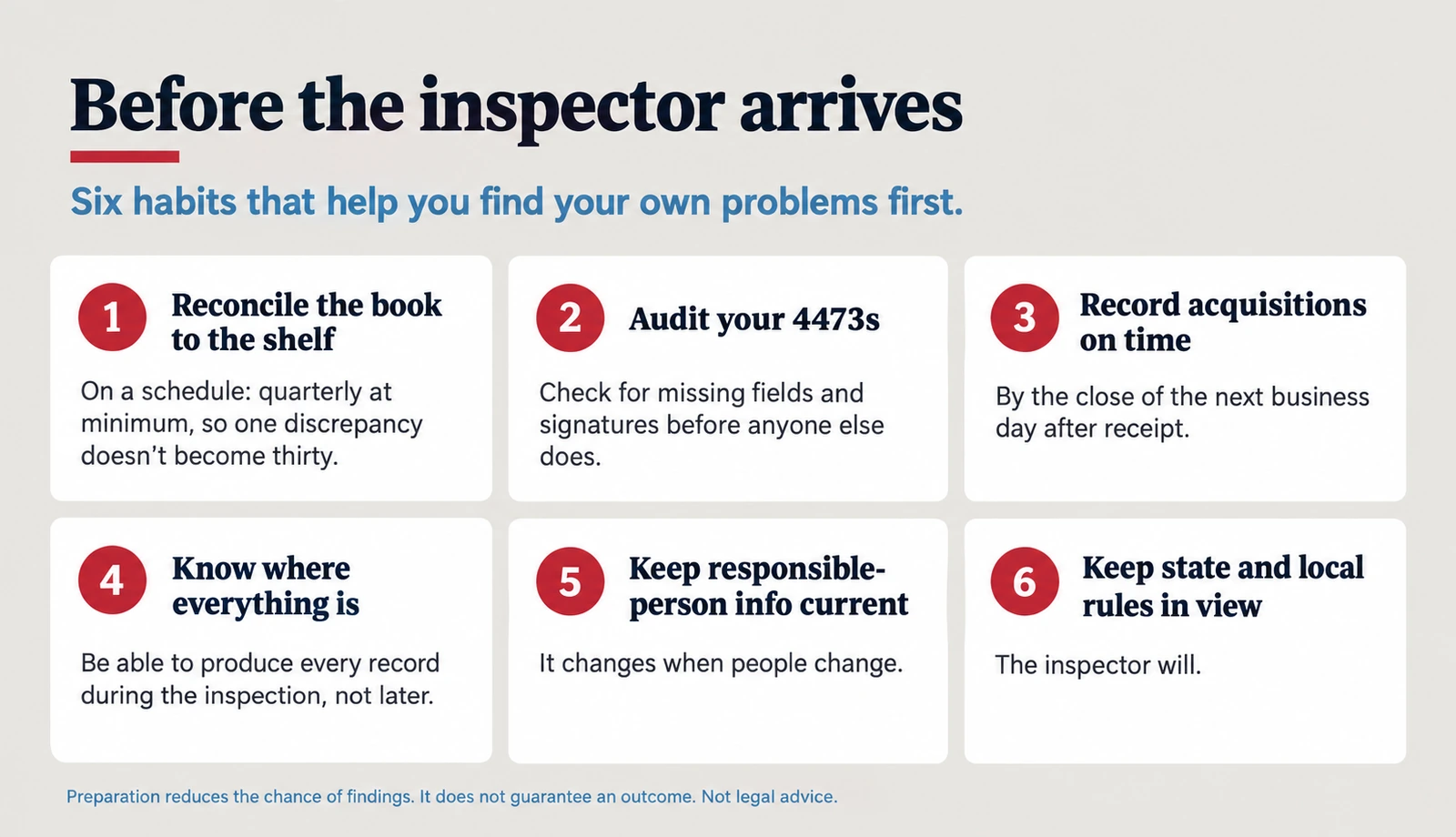
- Reconcile the book against the shelf, on a schedule. Quarterly at minimum. The point is that a discrepancy surfaces while it is one discrepancy, not thirty.
- Audit your 4473s for completeness rather than assuming. Missing signatures and unanswered questions are the cheapest findings to prevent and among the most commonly cited.
- Record acquisitions on time. By the close of the next business day. Late entries are their own violation, independent of whether the data is right.
- Know where everything is. If a record cannot be produced during the inspection, being able to produce it later is not the same thing.
- Check your responsible-person information is current. It changes when people change, and nobody remembers to tell ATF.
- Keep your state and local obligations in view. The IOI will.
⚠️ On refusing an inspection: declining to let an IOI enter the premises or examine records and inventory is treated as a willful violation of the Gun Control Act, and ATF will pursue revocation of the license. If you believe something is wrong with how an inspection is being conducted, that is a conversation for your attorney, not a reason to refuse entry.
What preparation does and does not do
Preparation reduces the chance that an inspection finds something you could have found yourself. It does not guarantee an outcome, and no software can, including ours. What the outcome depends on is your records and your conduct.
The realistic goal is narrower and more achievable: find your own problems first. Every discrepancy you catch on a Tuesday is one an investigator does not catch later.