
Two permissions, not one
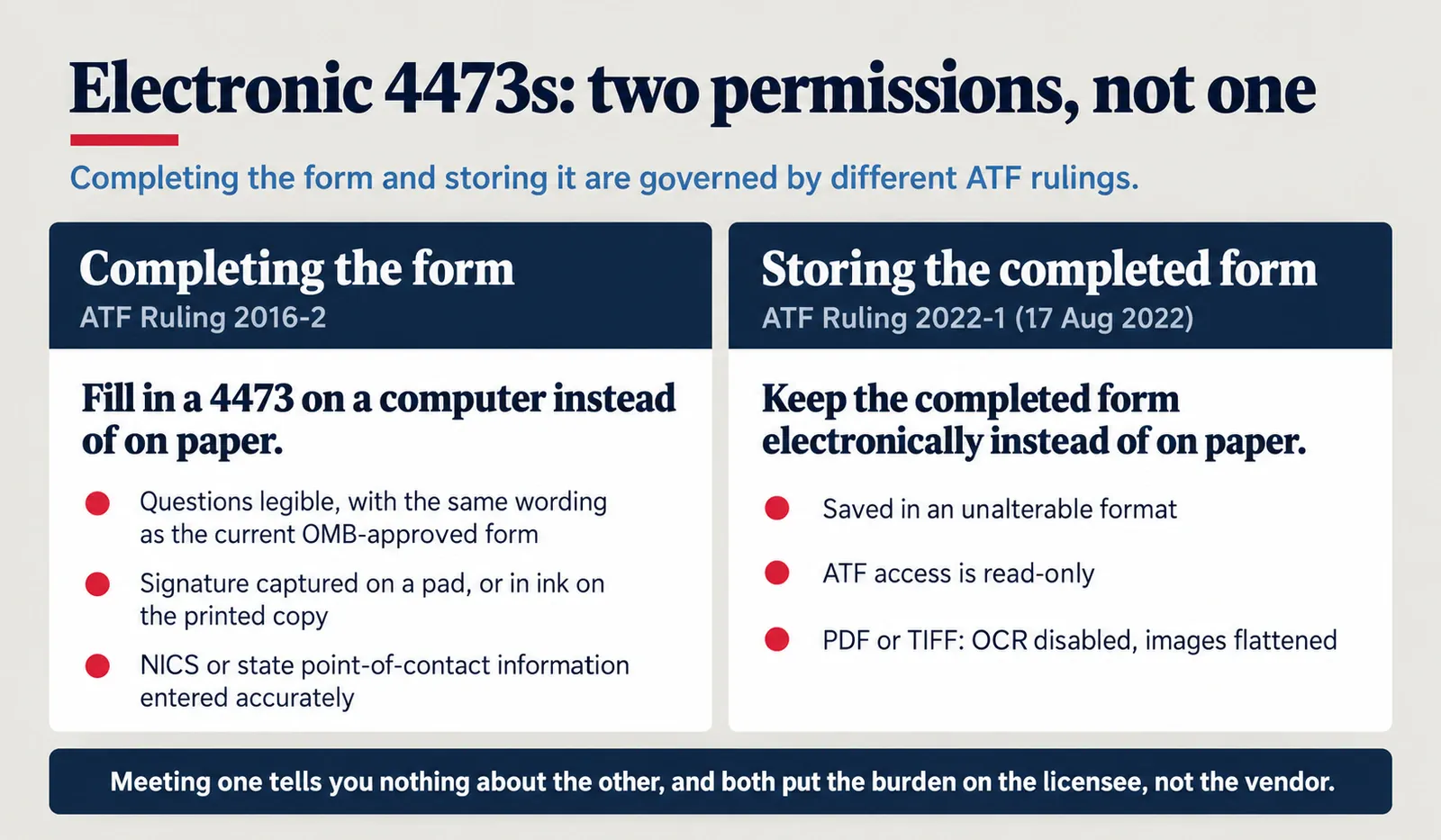
This is the part most guidance skips, and it matters when you are choosing software.
| Completing the form | Storing the completed form | |
|---|---|---|
| Governed by | ATF Ruling 2016-2 | ATF Ruling 2022-1 (17 August 2022) |
| What it allows | Filling in a 4473 on a computer instead of on paper | Keeping the completed form electronically instead of on paper |
| Meeting one means | Nothing about the other | Nothing about the other |
A system can let you complete a 4473 on a screen and still leave you printing and filing the result. When you evaluate any vendor, including us, ask which of the two they actually support.
Completing a 4473 electronically: Ruling 2016-2
Ruling 2016-2 permits electronic completion, subject to a list of conditions. What it requires:
- You use either your own e4473 software or ATF's own e-Form 4473, downloaded from their site.
- The questions on screen must be legible and must use the same wording as the current OMB-approved version of the form. Not paraphrased, not tidied up.
- Signatures may be captured electronically on a signature pad before the form is printed, or written by hand in ink on the printed copy.
- NICS or state point-of-contact information must be entered accurately in the applicable fields, whether auto-populated or typed.
⚠️ The ruling puts the burden on you, not on your vendor. It is the licensee's responsibility to verify that the software meets every condition. A vendor saying "we're 2016-2 compliant" is a starting point for that check, not the end of it, and that includes us.
Storing completed 4473s electronically: Ruling 2022-1
Ruling 2022-1 permits keeping the electronic version instead of paper, subject to its own conditions. The significant ones:
- The form must be saved in an unalterable format. The ruling states that original electronic Forms 4473 must be retained and may not be deleted, amended, replaced or otherwise altered.
- ATF access must be read-only, with at least one access point or terminal available for every 500 forms executed in the previous 12 months.
- Existing paper forms may be digitally scanned where they are more than three years old, measured from the date the transfer occurred.
- If forms are stored as PDF or TIFF, optical and intelligent character recognition must be disabled, and images must be flattened and not electronically searchable.
That last pair surprises people: the ruling deliberately requires stored images not to be text-searchable.
How long completed 4473s must be kept
Until you discontinue the business or licensed activity. ATF's final rule effective 24 August 2022 replaced the previous fixed terms: 20 years for a completed transfer, five years for certain voids and denials.
A rule proposed on 6 May 2026 would return to a fixed term. It is a proposal and not the rule in force.