
What has to be recorded
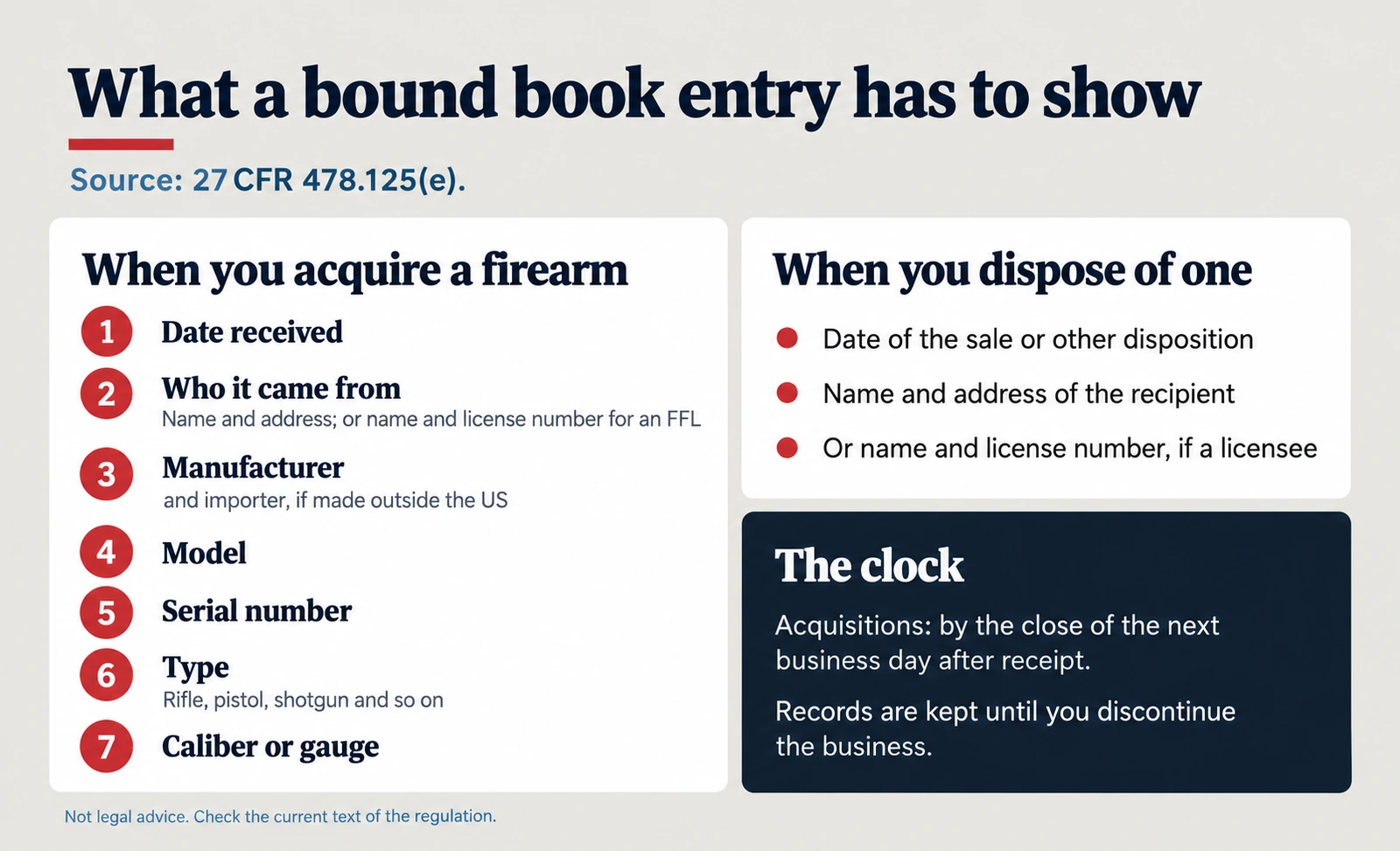
For each firearm you acquire, the record has to show:
- The date you received it
- Who you received it from: name and address for a non-licensee, or name and license number for another FFL
- The manufacturer's name, and the importer's name if the firearm was made outside the US, or if a US-made firearm was exported and later re-imported
- The model
- The serial number
- The type: rifle, pistol, shotgun and so on
- The caliber or gauge
For each firearm you dispose of, the record has to show the date of the sale or other disposition, and the name and address of the person it went to, or their name and license number if they are a licensee.
The requirement sits in 27 CFR 478.125(e), which also prescribes the format.
When the entry is due
Acquisitions: no later than the close of the next business day after you receive the firearm.
There is one narrow allowance. 27 CFR 478.125(g) permits a delay of up to seven days where you hold a commercial record (an invoice, typically) that already contains every piece of information the bound book requires. If the invoice is missing any required field, the allowance does not apply.
Dispositions have their own deadline, and it is not the same as the acquisition deadline. Check 27 CFR 478.125(e) for the current text rather than relying on a summary, including this one.
How long records must be kept
This changed in 2022, and a lot of published guidance has not caught up.
Under ATF's final rule effective 24 August 2022, Forms 4473 and acquisition and disposition records must be retained until you discontinue the business or licensed activity. The previous fixed terms (20 years for a completed transfer, five years for certain others) no longer apply.
A rule proposed on 6 May 2026 would reduce A&D retention back to a fixed term of 20 or 30 years. It is a proposal. It is not the rule in force, and it should not be treated as one.
Where the 20-year figure still appears: paper A&D records with no open disposition entries, and no dispositions recorded within 20 years, may be stored at a separate location. That location then becomes part of your business premises and is subject to inspection. That is an archiving provision, not a shorter retention period: the records still have to exist.
Keeping the record electronically
ATF Ruling 2016-1 permits an electronic A&D record instead of paper, provided its conditions are met. The ones that most often catch people out:
- Every required field lives in the system. You may not rely on invoices or any paper process to supply information the record requires.
- The record must be readily accessible from a computer at the licensed premises during business hours. Cloud or a hosted server is acceptable; being unable to produce the record on the premises is not.
- The system must support queries by serial number, acquisition date, manufacturer or importer name, purchaser name, purchaser address, and the Form 4473 transaction serial number.
- The data must be backed up at least daily.
Read the ruling's full conditions before relying on any system, including ours. Ruling 2016-1 places the obligation on you, the licensee, not on your software vendor.